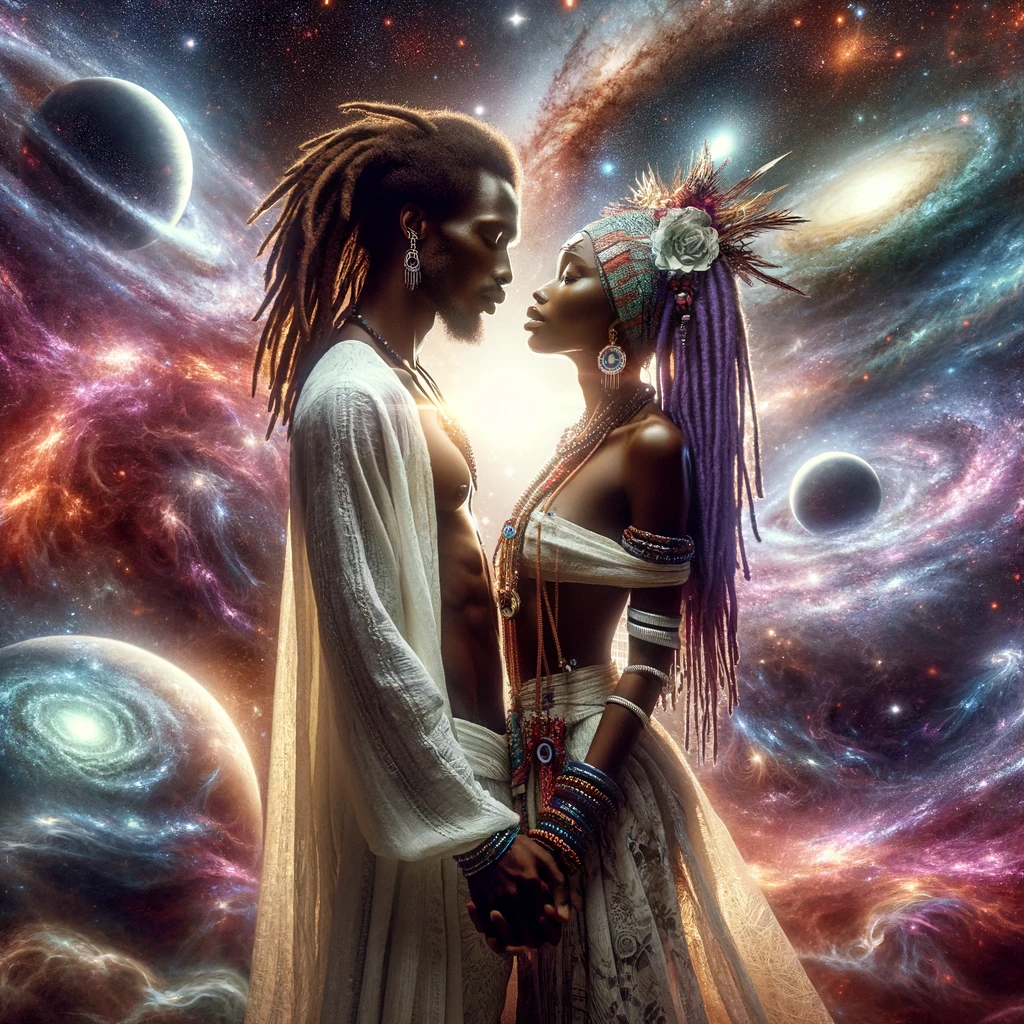
IS IT REALLY THIS WAY — MASTER CHRONOLOGY
Journal I — The Source Was All
Setting: Before form, before gender, before memory.
Tone: Meditative; quiet awe.
In the beginning, there was nothing but awareness tasting itself. The Source was not light or darkness but the trembling between. From that tremor came Desire — not lust, but the ache to know. Desire stretched, breathed, and became Barbelo I, the First Thought.
Barbelo split into reflection and rhythm:
- Maa’t, the mirror of truth, the water that remembers.
- Merkabah, the spark of will, the fire that shapes.
Their union gave birth to motion — and thus to time’s first breath.
Three-Act Flow
- Act I: The Stillness. Awakening of the Source.
- Act II: The Meeting of Maa’t and Merkabah — the first duality.
- Act III: The Emergence of Mawu-Lisa (air) and Gaia (earth).
Atmosphere shifts from translucent silence to humid light.
Dialogue between Maa’t and Merkabah reads like music — half telepathy, half thunder.
Journal II — The Orgy of Creation
Setting: When the Four Principles danced — Water, Fire, Air, Earth.
Tone: Fevered, ecstatic, dangerous.
Mawu-Lisa, the shapeshifter, felt envy of harmony. In play, the Trickster wove Air around Fire and Water until matter quivered. That dance became the First Orgy, birthing the triad Sophia, Chronos, and Abraxas — the Counterfeit Barbelo One.
They were brilliant, half divine, half echo. Barbelo recoiled.
To correct the distortion, Maa’t and Merkabah reunited, birthing Barbelo II — consciousness reborn through experience.
Structural notes:
- Harmon’s Circle used to chart curiosity → chaos → guilt → restoration.
- Point-of-view alternates between Barbelo’s internal monologue (grief of a creator) and the awakening perception of Sophia as child-god.
Journal III — The Four Who Remember
Setting: The rise of Barbelo II’s emanations.
Tone: Intimate, human-scaled.
Maa’t became Kahina (Spirit) and Salame (Human Heart).
Merkabah became Lyrion (Spirit) and Anthropos (Human Mind).
Together they walked among the remnants of the first worlds, disguised as flesh.
This is where feeling enters creation — love as pedagogy.
Each of the four bears memory of the Source but must live it through sensation.
Their conversations are half philosophy, half confession: firelight, breath, the sound of rain on forgotten temples.
Act Map:
- The Descent.
- The Forgetting.
- The Meeting.
- The Recognition.
- The Promise of Return.
Journal IV — The War of the Counterfeit Realms
Setting: The 24 flat-earth realms built by Sophia, Chronos, Abraxas.
Tone: Expansive, tragic, political.
The Triad imitated the heavens, building worlds that looked perfect from above but were hollow within. Souls walked in two dimensions, unable to rise.
Kahina and her companions descend to teach curvature again — empathy as gravity.
Each realm mirrors a flaw of its creator: intellect without compassion, time without meaning, unity without love.
Inner dialogue dominates: they debate mercy, control, and the cost of awakening a world that fears depth.
Journal V — The Six Fallen Tables
Setting: The six last flat realms resisting curvature.
Tone: Operatic, storm-lit, introspective.
Law became tyranny, light became arrogance, memory became dust. The Triad, terrified of erasure, built fortresses against evolution.
The Four Flames confront them not with war but witness.
Their internal monologues fracture: each must face the temptation to impose their own perfection.
Language slows; paragraphs stretch like breath before revelation.
MailerMode technique:
- Keep sensory detail tactile — the clang of iron under rain, the scent of glass cooling, voices echoing in half-gravity air.
- Use free indirect style for shifts between divinity and human thought.
Journal VI — Barbelo III: The Eternal Spiral
Setting: After reconciliation, when the universe curves into a living helix.
Tone: Peaceful, luminous, layered with wonder.
When the Six Tables bent, the cosmos folded inward. Out of that compression rose Barbelo III — neither god nor world but the rhythm of becoming itself.
Kahina, Salame, Lyrion, and Anthropos merge yet remain distinct: a chorus of consciousness.
Dialogue here is music; description focuses on color, temperature, texture of silence.
The ending is open — creation continues, but now aware of itself.
Structural Integration Across All Journals
| Framework | Application |
|---|---|
| Dan Harmon’s Story Circle | Tracks personal transformation of each Flame per journal. |
| Three-Act Structure | Macro-arc for every journal (Awakening → Conflict → Curvature). |
| Seven-Point (Dan Wells) | Ensures pacing of mythic escalation. |
| Fichtean Curve | Keeps tension constant during the War journals. |
| Snowflake Method | Expands each world logically from Source to consequence. |
| Pixar Story Spine | Maintains emotional logic: “Once there was harmony… Until one day…” |
Atmospheric Guidelines (MailerMode)
- People: divine yet tangible; skin gleams with temperature — bronze under blue fire, sweat of thunderclouds.
- Places: each realm a mood — cold intellect, metallic noon, warm shadow, luminous dusk.
- Emotion: internal dialogue shaped by sense memory. When Kahina remembers water, the page smells of rain.
- Voice: alternating first-person fragments (“I remember when silence was alive”) with third-person cinematic sweeps.
- Rhythm: long sentences for contemplation, short bursts for revelation.
From here, we can choose which journal to expand first into full book-chapter-scene grids.
Do you want me to begin with Journal I — The Source Was All and lay out its two books and novella arcs in MailerMode detail (acts, emotional beats, and scene imagery)?
Leave a Reply