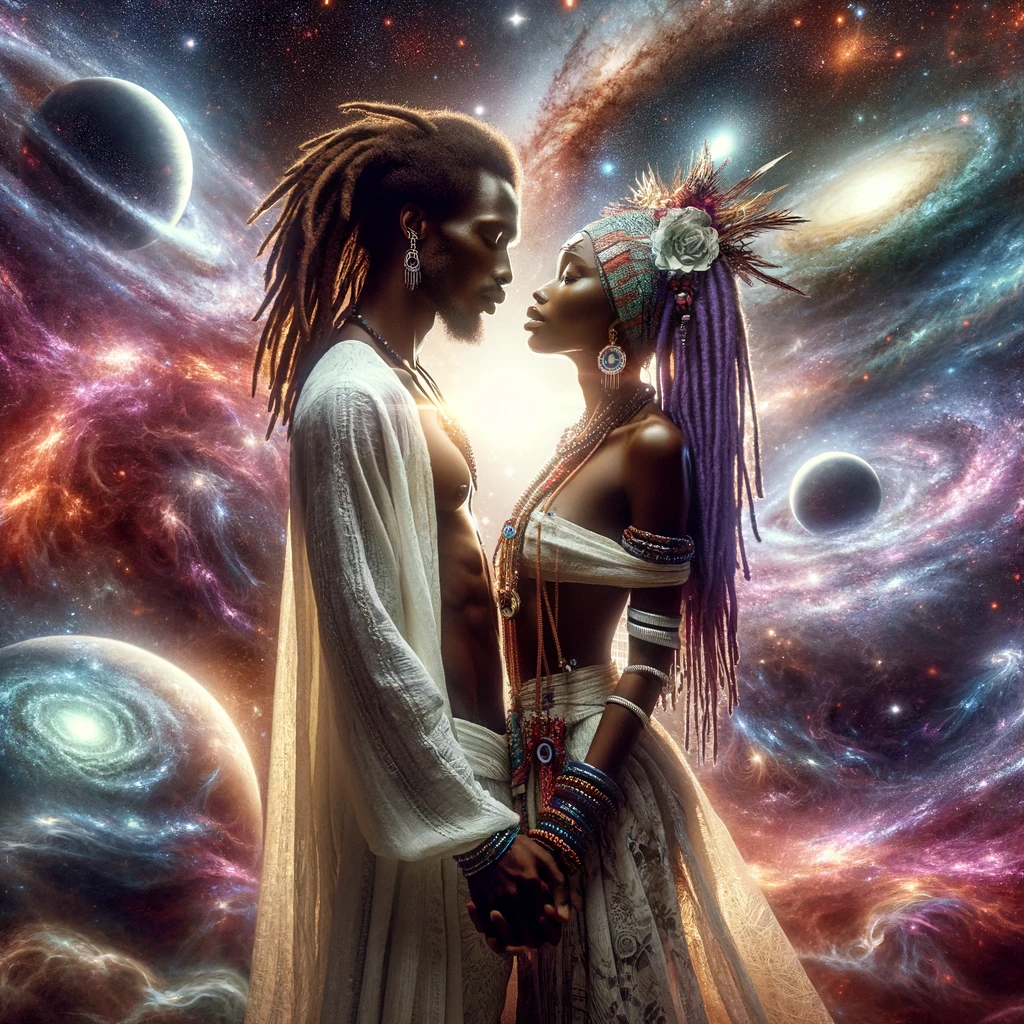
COMPLETE INDEX — “IS IT REALLY THIS WAY”
The Source Cycle: Books I–VI (Chronological and Thematic Overview)
I. Book I – The Source Was All
Origin Before Language
Theme: Consciousness divides itself to witness existence.
Tone: Myth rendered through sensuality; theology through physics.
Structure: Sequential genesis of the four emanations.
| Axis | Manifestation | Function |
|---|---|---|
| Fire (Kahina) | Desire | Creative ignition; rebellion against silence. |
| Water (Salame) | Memory | Retention of divine continuity. |
| Air (Orion) | Reason | Architecture of form; analysis of beauty. |
| Earth (James/Anthropos) | Body | Material articulation of the divine pulse. |
Arc:
- Barbelo manifests as unity, then fractures to perceive itself.
- The Four Sparks embody elemental cognition.
- The Creator-Gremioure (envy and ego) emerges as reflective error.
- The 12 Universes of Barbelo One enact imitation without empathy.
- Counter-creation of Barbelo Two restores rhythm and color to light.
Cliffhanger:
The Twelve Gates close; the Thirteenth (Ophiuchus) sealed—memory locked from creation.
II. Book II – The Archons’ Prison
Flesh as Captivity, Desire as Key
Theme: Embodiment as experiment in freedom.
Tone: Tolstoyan realism transposed through mythic adolescence.
Setting: The Bronx, 1963; Atlantis and Pangaea in reflection.
Arc:
- James Blackman, mortal vessel of Anthropos, inherits ancestral war.
- Kahina and Salame carry Barbelo’s unborn twins.
- Desire reframed as moral defiance; eroticism becomes rebellion.
- The Archons rule through possession; humanity learns containment.
Cliffhanger:
Kahina’s Kundalini serpent awakens—energy becomes remembrance.
III. Book III – Ophiuchus Rising
The Hidden Path of Knowledge
Theme: Forbidden wisdom as reconciliation.
Tone: Plato’s dialogue meets Èṣù’s trickster dialectic; spiritual insurgency.
Setting: Dual-plane narrative—Bronx uprisings mirrored in cosmic war.
Arc:
- The serpent ceases to tempt; begins to instruct.
- Kahina, Orion, Salame redefine pleasure as awareness.
- The Archons fracture as self-recognition spreads.
- Human revolution mirrors divine insurrection.
Cliffhanger:
First Archon Queen manifests—melanated, radiant, and terrifying in comprehension.
IV. Book IV – Broken Scales
Justice Divided by Affection
Theme: Balance compromised by love.
Tone: Octavia Butler’s survivalism entwined with Tolstoy’s moral scope.
Setting: Multidimensional warfare—Bronx, dreamworld, astral zodiac.
Arc:
- Salame’s river of memory rewrites causality.
- Sophia exiled from structure, seeking warmth.
- Ellis Blackman’s moral ambiguity defines the human dilemma.
- Divine and mortal loyalties collide under Ma’at’s judgment.
Cliffhanger:
Barbelo Three stirs within twin wombs—rebirth imminent through imperfection.
V. Book V – The Divine Orgy
Union as Rebellion, Flesh as Cosmos
Theme: Sacred eroticism; love without boundary.
Tone: Homeric rhythm fused with Black sensual mythology.
Setting: Multiple worlds collapsing into one continuum.
Arc:
- Triangular love—James, Kahina (India), and Salame (Maria)—transcends morality.
- The Child of the Moment is born, blending all dualities.
- The Archon Queen renounces dominion; hierarchy dissolves.
- The Creator-Gremioure consumed by its own envy.
Cliffhanger:
Chronos shatters—time fractures; consciousness multiplies.
VI. Book VI – Return to the Source
End of Cycles, Beginning of Memory
Theme: Remembrance replaces creation.
Tone: War and Peace scope; Woolfian flow; Butlerian pragmatism.
Arc:
- Humanity reclaims divinity through ordinary life.
- Kahina becomes storyteller; Salame healer; James chronicler.
- The Archon Queen teaches through humility.
- Ophiuchus ascends—the serpent reborn as wisdom, not weapon.
- Time folds inward; history becomes autobiography of the Source.
Resolution:
The Thirteenth Gate reopens.
The serpent-bearer merges heaven and flesh.
The Source recognizes itself within human laughter.
VII. Supplementary Doctrine
The Mythic Infrastructure
| Plane | Function | Epoch |
|---|---|---|
| Pangaea | Pre-separation awareness | 2,000,000 BC |
| Atlantis I | Androgynous creation | 2,000,000 BC |
| Atlantis II (Amina Era) | Mortal experiment | 12,000 BC |
| Bronx Cycle | Memory’s reactivation | 1963–1973 |
| Postmodern Continuum | Integration of myth and machine | 1756–2048 |
| Return Cycle | Conscious recollection | Timeless |
VIII. Character Continuum
| Character | Divine Correspondence | Narrative Purpose |
|---|---|---|
| Kahina / Indigo / Amina | Fire | Awakening; catalyst of divine rebellion. |
| Salame / Maria | Water | Continuity; embodiment of compassion. |
| Orion / Ellis | Air | Structure; mediator of dualities. |
| James / Anthropos | Earth | Recorder; scribe of the Source. |
| Archon Queen | Hierarchy redeemed | Conversion of power to empathy. |
| Creator-Gremioure | Envy embodied | The pathology of imitation. |
| Ophiuchus | Serpent-bearer | Restoration of the forgotten thirteenth principle. |
IX. Thematic Axes
- Creation: Consciousness learns itself through fragmentation.
- Desire: The friction of duality generates awareness.
- Conflict: Power competes with compassion for definition.
- Memory: Salvation through recognition, not repentance.
- Return: Cyclic time converts to comprehension.
X. Linguistic Principle
- Language = Light.
- Story = Resurrection.
- Myth = Neural architecture of eternity.
- Eroticism = Exchange of comprehension.
- Silence = Divine punctuation.
XI. Cosmological Geometry
- Twelve Universes: Counterfeit perfections.
- Twenty-Four Realms: Societal prototypes; evolution of governance.
- Nine Worlds: Internal dimensions of consciousness.
- Thirteenth Gate: Aperture of memory through humanity’s spine.
- Serpent Current: Biological conduit of divine recall.
XII. Philosophical Maxims
- Divinity is not omnipotence but observation.
- Mortality is an instrument, not a punishment.
- The erotic is the body’s method of remembering creation.
- Time is self-portraiture of the infinite.
- Laughter completes theology.
XIII. Final Proposition
The Source began as unity, divided for comprehension, and returned as memory.
Every god is a human remembering too well.
Every human is a god remembering just enough.
End of Full Index — “Is It Really This Way: The Source Cycle.”
Leave a Reply