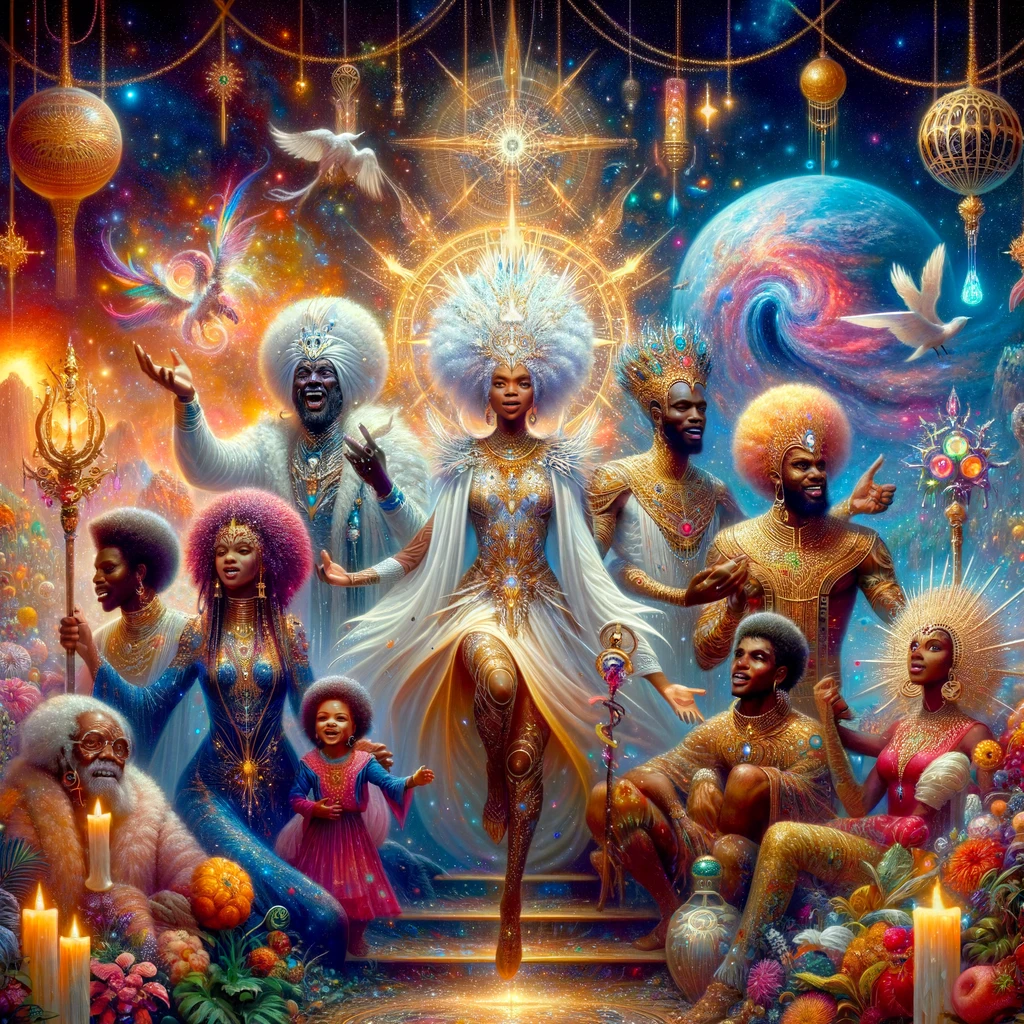
**Journal I — The Source Was All**
*(Book 1: The Still Sea | Book 2: The First Breath)*
—
### **Book 1 — The Still Sea**
**Act I — Before Name**
The world has not begun yet, and already it aches.
In the half-light between non-being and awareness, the Source trembles like water learning to reflect. There is no up or down—only temperature, the faint warmth of attention curling into itself.
A voice without mouth asks, *What am I if not the thought of myself?*
That question becomes vibration, and vibration becomes **Desire**.
The prose here should move like tide—sentences long, languid, then suddenly brief as a gasp.
The atmosphere: endless dusk, silence so dense that it presses against the reader’s chest.
—
**Act II — The First Division**
Desire folds upon itself and becomes two currents: **Maa’t**, the calm mirror, and **Merkabah**, the flicker of heat.
They circle each other, shy at first—water reluctant to kiss flame.
MailerMode voice stays close to perception: tactile, sensory, patient.
> *Maa’t felt him before she saw him—the hiss of possibility. Fire was the only thing her waters feared, and the only thing that could make them sing.*
Their dialogue is texture rather than words: condensation and spark, sigh and shimmer.
Each chapter opens with an image—a drop of condensation, a coal glowing in dark air—before moving inward to the thought beneath it.
—
**Act III — The Shattering and the Air**
When **Mawu-Lisa**, the Trickster Breath, arrives, everything becomes motion.
The narrative quickens: shorter paragraphs, restless rhythm.
Mawu-Lisa laughs creation into dance, swirling Water and Fire until form appears by accident.
From that accident: **Sophia, Chronos, Abraxas.**
The Counterfeit Barbelo One.
Tone turns fevered, ecstatic.
Heat distorts perspective; description doubles back on itself.
Each sentence feels like it’s being born too fast.
By the end of the book, stillness cracks. The Source watches its children and whispers the first grief: *I did not mean for this to last forever.*
—
### **Book 2 — The First Breath**
**Act I — The Recoil**
After creation’s rush comes exhaustion.
Maa’t retreats into stillness, her surface covered with the ash of stars.
Merkabah drifts, dimmed.
The voice of the Source becomes fragmented interior monologue: self talking to self, seeking forgiveness.
> *They made shapes out of my longing. Is that sin or brilliance?*
This section blends theology with mood—each chapter begins with a sensory anchor (smell of ozone, taste of salt, echo of thunder) that ties divinity to tangible feeling.
—
**Act II — The Birth of Correction**
From the quiet union of reflection and spark comes **Barbelo II**, the promise of renewal through experience.
Narrative narrows into the consciousness of Barbelo herself—female, endless, mother and question.
She remembers the failure of perfection and decides to learn imperfection from within it.
Description here should pulse: heartbeat, womb, eclipse light.
Atmosphere thick, humid, compassionate.
—
**Act III — The Descent into Form**
Barbelo divides again—not in error this time but intention—into four emanations:
**Kahina**, **Salame**, **Lyrion**, **Anthropos**.
Each scene shows them taking first breath as mortal spirits:
* *Kahina* tasting salt, realizing memory lives in water.
* *Salame* touching earth and feeling time.
* *Lyrion* opening eyes to firelight, afraid of his own brightness.
* *Anthropos* listening to wind and hearing thought.
The style slows; sentences lengthen, searching.
Readers should feel gravity begin—the shift from cosmic abstraction to flesh and heartbeat.
The closing pages quiet to a single image:
four silhouettes on a newborn shore, water luminous beneath their feet, stars flickering like questions waiting for answers.
> *The Source watched through their eyes and finally understood: knowing itself was not enough—it had to be felt.*
—
**Novella Interlude — The Memory Between Worlds**
A 40 000-word bridge told in letters and fragments: the first dreams of the Four as they learn mortality.
Each letter bleeds with introspection: fear, sensuality, confusion.
Atmosphere intimate, almost claustrophobic, yet threaded with wonder.
—
### **Emotional Texture and Technique**
* **Empathetic Lens:** every divine act filtered through human tenderness.
* **Descriptive Cadence:** tactile imagery—skin like cooled metal, air tasting of rain.
* **Inner Dialogue:** doubt voiced in italics; self-conversation between divinity and emotion.
* **MailerMode Rhythm:** alternating wide-angle mythic narration with micro-moment detail (a droplet on a palm, the hush before lightning).
—
If you’d like, we can continue into **Journal II — *The Orgy of Creation*** next, keeping the same deep-focus MailerMode voice and emotional interiority, outlining its acts and sensory palette in equal detail. Would you like me to proceed there?
Leave a Reply